
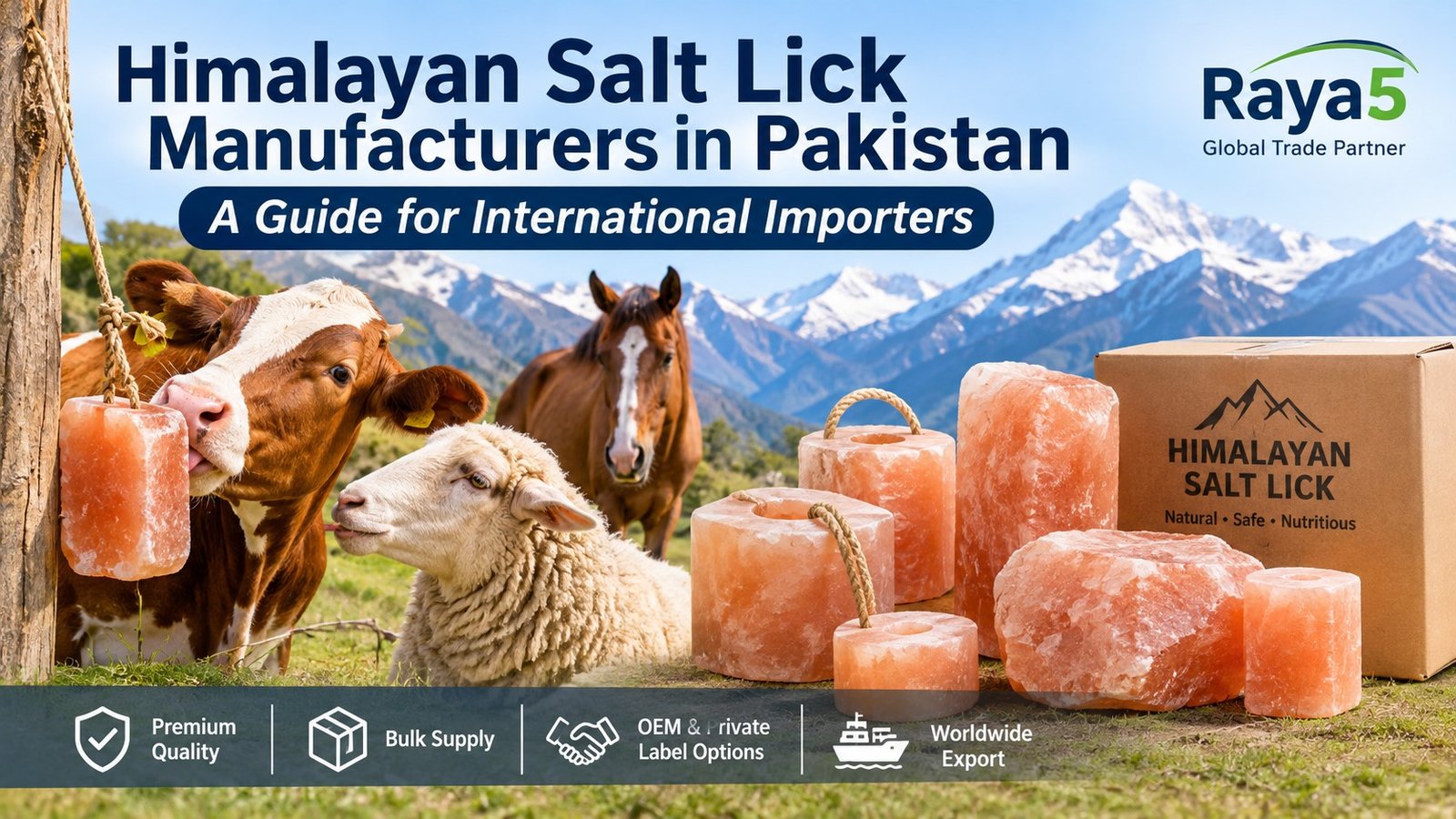
Himalayan Salt Lick Manufacturers in Pakistan: A Guide for International Importers
Introduction
Pakistan is an established source of natural Himalayan pink salt, including salt blocks used for livestock and animal nutrition applications. International importers, livestock feed distributors, agricultural wholesalers and private-label brands source Himalayan animal salt licks for resale through agricultural supply networks and specialist retail channels.
For buyers planning bulk purchases, selecting the right supplier involves more than comparing prices. Product weight, block consistency, drilling quality, rope attachment, packaging, export documentation and shipping arrangements all influence the suitability of a shipment.
Raya5 & Co. supplies Himalayan salt products from Pakistan and supports international B2B buyers with product sourcing, specifications, packaging options and export coordination. This guide explains the main considerations when sourcing Himalayan animal salt licks from Pakistan.
1. Why Source Himalayan Salt Licks from Pakistan?
Pakistan’s Salt Range, particularly the Khewra region of Punjab, is internationally recognised for its Himalayan rock salt deposits. This natural resource supports the supply of salt products for different commercial and industrial applications.
For international buyers, sourcing from Pakistan offers several potential advantages:
- Natural salt origin: Himalayan rock salt sourced from Pakistan’s Salt Range.
- Product variety: Different block weights, shapes and configurations for livestock applications.
- Bulk supply options: Products can be arranged for wholesale and container-based orders.
- Custom packaging: Options for individual wrapping, master cartons and private-label requirements.
- Export coordination: Support with commercial documentation, shipment planning and international trade arrangements.
Buyers should evaluate each supplier based on its actual sourcing arrangements, processing capabilities, quality controls and ability to meet the required export specifications.
2. What Are Himalayan Animal Salt Licks?
Himalayan animal salt licks are solid blocks made from natural rock salt. They are designed to provide livestock and other animals with access to salt through licking.
Depending on their size and design, these blocks may be used in farms, stables, livestock facilities and pasture environments.
Common target animals include:
- Cattle and dairy livestock
- Sheep and goats
- Horses
- Deer and selected wildlife applications
Salt licks are available in different weights and configurations. Some are supplied with ropes for hanging, while others are designed as larger blocks for placement in suitable feeding areas.
Important: Salt licks are not complete mineral or nutritional supplements. Their suitability depends on the animal species, overall diet and nutritional requirements. Buyers should obtain appropriate livestock nutrition or veterinary guidance when selecting products for specific animals.
3. Types of Himalayan Animal Salt Licks
International buyers can consider several product configurations depending on their distribution channel and intended application.
Rope-Attached Himalayan Salt Licks
These blocks have a drilled central hole and are supplied with an attached rope. They are commonly selected for hanging in suitable livestock areas, including stables and animal enclosures.
Available rope options may include polypropylene (PP) and hemp, depending on the order specification.
Machine-Drilled Salt Blocks
Machine-drilled blocks have a central hole designed for rope attachment. Buyers should assess drilling consistency, hole positioning and block strength to reduce the risk of damage during handling and use.
Natural-Shape Himalayan Salt Blocks
These products retain a more natural appearance and are available in larger weights. Depending on the design, they may be supplied with a drilled-hole option or intended for ground placement.
The right product depends on the buyer’s market, animal application, retail requirements and preferred packaging format.
4. Available Sizes and Product Specifications
Raya5’s product range includes several weight categories to accommodate different wholesale and livestock distribution requirements.
| Product weight | General product configuration |
|---|---|
| 1.0–1.5 kg | Hand-crafted or machine-drilled blocks with PP or hemp rope |
| 2–3 kg | Machine-drilled blocks with rope attachment |
| 5–6 kg | Standard livestock blocks designed for slower weathering |
| 10–20 kg | Extra-large blocks or natural-shape salt blocks; drilled-hole option or ground placement |
The final specification should be confirmed before placing an order.
Buyers should request details covering:
- Individual block weight and dimensions
- Shape and surface finish
- Drilled-hole diameter and positioning, where applicable
- Rope material and attachment
- Product appearance and acceptable natural variation
- Packaging configuration
- Inspection and quality requirements
Natural rock salt can vary in colour, texture and appearance. Importers should agree on acceptable product tolerances and sample approval requirements before confirming a bulk shipment.
5. Manufacturing, Processing and Quality Control
The processing requirements for Himalayan animal salt licks depend on the selected product design and order specifications.
A typical production and preparation process may include:
- Raw salt selection: Selecting suitable Himalayan rock salt for the required product size and application.
- Cutting and shaping: Preparing blocks according to the agreed weight and dimensions.
- Drilling: Creating central holes for rope-attached products where required.
- Rope attachment: Fitting the specified polypropylene or hemp rope.
- Product inspection: Checking block condition, dimensions, drilling and rope attachment.
- Packaging: Preparing individual units and master cartons according to the approved packing specification.
For bulk orders, buyers should discuss inspection criteria before production or order preparation begins.
Particular attention should be given to block cracks, excessive breakage, drilling defects, rope security and packaging strength. These factors can affect product presentation and damage rates during transportation.
Importers may also arrange third-party inspection through an independent inspection company when required.
6. Bulk Packaging and Export Logistics
Packaging plays an important role in protecting Himalayan salt licks during inland transportation, container loading and ocean freight.
Common packaging arrangements include:
- Individual shrink wrapping
- Product labels and barcode stickers
- Master cartons containing approximately 4–10 salt licks, depending on product size
- Reinforced pallet arrangements where required
Packaging specifications should be agreed according to the block weight, dimensions, destination-market requirements and buyer’s distribution needs.
Container Loading
Container loading capacity depends on several factors, including:
- Individual product dimensions and weight
- Carton size and stacking arrangement
- Palletised or non-palletised loading
- Container payload restrictions
- Shipping-line and route requirements
For this reason, importers should request a product-specific loading plan rather than rely on a general container-capacity estimate.
Raya5 can coordinate loading and packaging arrangements according to the confirmed order specification.
7. Private Label and OEM Opportunities
Importers and distributors may prefer to sell Himalayan animal salt licks under their own brands. Private-label and OEM arrangements can help buyers maintain consistent branding across their product portfolios.
Depending on the order requirements, packaging customisation may include:
- Buyer logo and brand identity
- Product labels and barcode stickers
- Individual product information
- Batch identification
- Custom master cartons
- Multilingual packaging information
Buyers should provide their artwork, labelling instructions and destination-market requirements before production or packaging approval.
For first-time OEM orders, it is advisable to approve a packaging sample or digital artwork proof before proceeding with the full order.
8. Export Documentation and Shipping Terms
International shipments require appropriate commercial and transport documentation. The exact requirements depend on the importing country, product classification and destination regulations.
Common export documents may include:
- Commercial invoice
- Packing list
- Bill of Lading
- Certificate of Origin
- Certificate of Analysis (COA), where applicable
- Inspection or fumigation documents, where required
Importers should confirm the applicable HS code, customs classification, product admissibility, labelling requirements and any relevant import permits with their customs broker or local authorities.
Available Shipping Terms
Raya5 can discuss shipment arrangements under commonly used Incoterms 2020, subject to the agreed transaction:
- FOB Karachi / Port Qasim: The seller’s delivery responsibility is fulfilled according to the agreed FOB terms at the named port.
- CFR: The seller arranges and pays the cost of carriage to the named destination port.
- CIF: The seller arranges carriage and insurance to the named destination port.
- EXW / FCA: These options may be considered depending on the buyer’s collection and transportation arrangements.
The selected Incoterm, named port and allocation of costs and responsibilities should be clearly stated in the sales contract or proforma invoice.
9. How to Select a Reliable Pakistani Salt Lick Supplier
Before placing a bulk order, international buyers should evaluate suppliers against practical commercial and quality criteria.
1. Confirm product origin: Ask for clear information about the Himalayan salt source and product description.
2. Review specifications: Confirm available weights, dimensions, drilling options, rope material and packaging.
3. Request product samples: Samples help buyers evaluate appearance, block condition, finishing and overall suitability.
4. Assess quality control: Discuss inspection procedures, acceptable tolerances and how damaged or defective products are handled.
5. Check export capabilities: Confirm experience with commercial documentation, container planning and international shipment coordination.
6. Clarify private-label requirements: Agree on artwork, labelling, carton specifications and order quantities before production.
A supplier’s ability to communicate specifications clearly and provide realistic shipment information is an important part of a reliable B2B relationship.
10. Why Choose Raya5 & Co.?
Raya5 & Co. is a Pakistan-based exporter supplying Himalayan salt products and agricultural commodities to international B2B markets.
For Himalayan animal salt lick buyers, Raya5 supports product sourcing, specification coordination, packaging arrangements, private-label requirements and export logistics.
Buyers can discuss different block weights, rope options, carton configurations and shipment requirements according to their market needs.
Our approach is based on clear commercial specifications, practical order coordination and transparent communication throughout the export process.
11. Frequently Asked Questions
What sizes of Himalayan animal salt licks are available?
Common available weights include 1–1.5 kg, 2–3 kg, 5–6 kg and 10–20 kg. Final availability and specifications should be confirmed for each order.
Can I import Himalayan salt licks in bulk from Pakistan?
Yes. Bulk orders can be discussed with Pakistani suppliers based on product specifications, packaging requirements, order quantity and shipment arrangements.
Are Himalayan salt licks available with ropes?
Yes. Rope-attached products can be supplied with polypropylene or hemp rope, subject to the agreed specification.
Can I order private-label Himalayan salt licks?
Private-label options may include customised labels, logos, barcodes, product information and master cartons. Requirements should be confirmed before the order is finalised.
How are Himalayan salt licks packaged for export?
Packaging can include individual shrink wrapping, labels, master cartons and reinforced pallets, depending on product size and buyer requirements.
Which shipping terms can be arranged?
FOB, CFR, CIF and other suitable arrangements can be discussed under Incoterms 2020, depending on the shipment and agreed contract.
What documents are required to import Himalayan animal salt licks?
Common documents include a commercial invoice, packing list, Bill of Lading and Certificate of Origin. Additional documents depend on the importing country’s regulations.
How can I request a quotation from Raya5?
Send your required product weights, estimated quantity, packaging preferences and destination port to Raya5. The sales team can review the requirements and prepare a quotation.
Conclusion: Request a Bulk Himalayan Salt Lick Quotation
Choosing the right Himalayan salt lick supplier involves evaluating product specifications, processing quality, packaging, private-label options and export capabilities.
For importers, wholesalers, livestock distributors and OEM brands looking to source Himalayan animal salt licks from Pakistan, Raya5 & Co. welcomes enquiries for bulk supply and customised export arrangements.
Request a quotation:
- Website: raya5.com
- Email: sales@raya5.com
- WhatsApp: +92 311 1270111
Share your required product sizes, quantity, packaging preferences and destination port to discuss your sourcing requirements with Raya5.